Eğitimde Devrim Niteliğinde Bilimsel Bir Çalışma

“Yazılım Dili Öğrenme Sürecinde Öğrenci Verimliliği”
Başlıklı bu çığır açan makale, günümüz eğitiminde Bilişim Teknolojileri’nin rolünü ve disiplinlerarası becerilerin önemini ele alıyor. Bilişsel düşünme ve dijital teknolojilerle desteklenen bir DIY kültürü(“Kendin Yap”) oluşturma yolunda, bu çalışma, öğrencilerin programlamaya dair korkularını nasıl yenebileceğini ve akran değerlendirmelerinin motivasyonu nasıl artırabileceğini inceliyor. Sonuçlar, eğitimde öğrenci-öğretmen dinamiğini dönüştürecek sürdürülebilir bir sistem oluşturmanın önemini vurguluyor.
Öğrenme stilleri ve performans değerlendirmeleri zamanla gelişmiştir. Geleneksel öğretim stratejileri, öğrencilerin ilgisini çekme ve performanslarını iyileştirme konusunda yükseköğretim kurumları için zorluklar yaratmaktadır. Bilgi Teknolojileri (BT), özellikle sürdürülebilir eğitim için küresel ekonomik büyümenin önemli bir itici gücü haline gelmiştir. Öğrencilerin BT gelişimini karşılamak için bilgisayar programlama dillerini öğrenerek bilişsel düşünmeyi geliştirmeleri gerekmektedir. Ancak öğrenciler sıklıkla bilgisayar programlama dili öğrenirken korku ve zorluklar yaşamaktadır. Bu araştırma, bilgisayar programlama dilinde mantık öğrenimi performansını incelemekte ve öğrenci performanslarının gelişimini değerlendirmek için ara sınav ve final sınavı notları kullanılmaktadır. Öğrenmenin dört önemli yönü; öğrenci merkezli, bilgi merkezli, değerlendirme merkezli ve topluluk merkezlidir. Geleneksel değerlendirme teknikleri ve öğretmen-öğrenci ilişkisi, öğrenciler üzerinde öğrenme heveslerini kaybetmelerine neden olacak kadar büyük bir baskı oluşturur. Buna karşılık, eğitimciler akran değerlendirmesini geri bildirim olarak kullandığında, öğretmen-öğrenci ilişkisi daha üretken hale gelir. Araştırmanın odak noktası, bilgi bilimi alanında birinci sınıf üniversite öğrencileridir. Öğrenciler deney gruplarına ayrılarak akran değerlendirmesiyle eğitilmiş, sonuçlar dönem sınavlarında raporlanmıştır. Bu çalışmanın literatür incelemesi, programlama mantığı öğrenmede karşılaşılan zorluklar, denklem programlama, etkileşimli öğretim platformlarına giriş ve ileri okumalar üzerinedir.
Literatür İncelemesi
Bu zorluğu ele almak için üniversiteler, genellikle İngilizce dilindeki kullanıcı arayüzü ve programlama dili tarafından korkutulan birçok öğrencinin dersi tamamlama konusunda özgüven kaybetme eğiliminde olduğu ve motivasyon eksikliği yaşadığı bir kampüs genelinde programlama kursları başlattı (Calder, 2010; Chen vd., 2020). Bu nedenle, bu çalışma programlamanın öğrenme ortamını iyileştirmek, öğrencilerin programlamaya ilgisini uyandırmak ve öğrencilerin programlamanın zor olduğu izlenimini iyileştirmek amacıyla blok programlama arayüzünü kullandı. Çalışmada kullanılan öğretim modeli öğrenci etkileşimini ve tartışmasını teşvik etti, akran tartışmasına ve çalışma paylaşımına olanak tanıyan bir öğrenme atmosferi oluşturdu. Bu öğretim modeli aynı zamanda öğrencilerin ifade, problem çözme ve grup işbirliğini teşvik etme yeteneklerini geliştirebilir. Akış şeması programlaması aracılığıyla, blok programlama arayüzü öğrencilerin programlama mantığını anlamak üzerine odaklanmalarına izin verir. Programlamayı tamamladıktan sonra öğrenciler, çalışmalarını mobil telefonlar üzerinde sunabilirler. Ayrıca, bu programlama yaklaşımı donanım cihazlarını da kontrol edebilir, sonuçların zenginliğini artırabilir ve öğrencilerin programlamayı öğrenme ilgisini artırabilir. Öğrencilerin öğrenme sonuçlarını değerlendirirken, bu çalışma karşılıklı değerlendirme için akran değerlendirmesi kullandı, öğrencileri diğer öğrencilerin çalışmalarının güçlü ve zayıf yönlerini analiz etmeye teşvik ederek kendi çalışmalarını daha iyi anlamalarına yardımcı oldu. Akran değerlendirme ve öğretmen değerlendirmesi, öğrenci başarısını, öğrenme yeterliliğini ve öğrenme isteğini artırıp artırmadığını incelemek için kullanıldı.
Bilgi eğitimi modern yükseköğretimin ayrılmaz bir parçasıdır. Bu eğitim biçiminin öğrencilere programlama sözdizimini ezberletmek değil, onları bir programcı gibi düşünmeyi ve sorunları çözmek için yaratıcı düşünmeyi nasıl geliştireceklerini öğretmek olduğunu belirtmek önemlidir (Calder, 2010; Finn ve Garner, 2011; Hillsdale vd., 2019; Ion vd., 2019; Hickey vd., 2020). Programlama eğitimini teşvik etmenin odak noktası, öğrencilerin programlama mantık yeteneklerini geliştirmektir. Geçmişte, programlama derslerinde öğrencilerin öğrenme hedefleri komut arayüzüydü. Programlamaya yeni başlayan öğrenciler için bu oldukça zordu ve öğrencilerin programlamaya hiç ilgi duymamalarına neden oldu (Kordaki, 2012). Öğrencilerin ilgisini çekmek için öğrencilerin programlama öğrenimindeki darboğazlarını anlamamız gerekmektedir (Liu vd., 2018a). Araştırma sonrası, öğrencilerin programlamaya ilgi duymalarını uyandırabilen üç adım olduğu bulundu. İlk adım, öğrencilerin hemen kendi tasarladıkları programlama çalışmalarını sergilemeleri gerektiği, örneğin iletişimi kontrol etmek için otomatik mobil araçlar ve robotları kullanma, blok program tasarlama ve sorunları çözmek için tasarlama gibi, programlamanın uygulamasını ve eğlencesini anlamak için (Liu vd., 2018b). İkinci adım, program kodlamasının arayüzünü basitleştirmektir ve üçüncü adım ise öğrencilerin problem çözme yeteneklerini geliştirmek ve sürdürülebilir bir gelişim hedefi olarak öğrencileri motive etmek için eğitim vermektedir (Luaces vd., 2018). Blok program tasarımı uygulayarak öğrencilere sorunları çözmek için program tasarlama öğretilir ve ilgili bilgi işlevi uygulamalarını tasarlama ve diğer alanları entegre ederek yenilikçi uygulamalar oluşturmak için diğer alanları entegre etmek öğrencilere öğretilir. Öğrenciler konuyla ilgili pratik uygulamada akranlarıyla çalışırken bağımsız düşünme yetenekleri de geliştirilir (Lundstrom ve Baker, 2009). Öğretim, öğrencilere belirli yetenekler ve beceriler kazandırma anlamına gelir. Bu nedenle, öğrenenlere nasıl yardımcı olacak değerlendirme yöntemlerini iyi kullanmak, öğretimin nihai sürdürülebilir gelişim hedefidir ve yükseköğretimdeki eğitimcilerin ilgilendiği önemli bir konudur (Mine ve Colin, 2018).
Son yıllarda, öğrencileri daha iyi motive etmek, performanslarını artırmak, destekleyici bir öğrenme ortamı oluşturmak ve sürdürülebilir eğitim geliştirmek
Blok Programlama
Bilgi eğitiminin amacı öğrencilere bilgiyi kullanarak sorunları nasıl çözeceklerini öğretmektir. Bu nedenle, öğrencilere programlama öğretme amacı, programlama dilini ezberletmek değil, programlama mantığı kullanarak sorunları nasıl çözeceklerini öğretmektir (Calder, 2010; Liu vd., 2018a). Mevcut araştırmalara göre, öğrencilerin programlama öğrenme konusundaki ilgisini çekmek için üç anahtar bulunmaktadır (Kordaki, 2012; Hillsdale vd., 2019). İlk olarak, programlama sürecinde öğrenciler, programlama sonucunu anında görebilirler; örneğin, bir robotu veya otomatik mobil bir aracı kontrol etmek için bir program kullanarak, öğrenciler sadece tamamladıkları veya değiştirdikleri programın kontrol ettiği robotun sonucunu anında görebilirler. İkinci olarak, programlamada yazılım arayüzü grafiklere dayalıdır, bu da öğrencilerin anlamasını kolaylaştırır. Üçüncü olarak, öğrencilerin program yazma düşünce mantığını yönlendirmek ve öğrencilere adım adım nasıl tam bir program yazacaklarını öğrenmelerine izin vermek. Geleneksel programlama dil geliştirme arayüzüne göre, blok programlama yukarıda bahsedilen üç anahtarı daha iyi karşılayabilir. Öğrenciler programlamanın mantığını düşünmeye odaklanabilirler ve öğrencilerin programlamayı öğrenmeye olan ilgisini teşvik edebilir. Bu nedenle, programlamayı öğrenmeye başlayanlar için daha uygulanabilir bir dilidir (Piteira ve Costa, 2013; Luaces vd., 2018; Papadakis, 2018; Papadakis ve Orfanakis, 2018; Ion vd., 2019; Papadakis ve Kalogiannakis, 2019; Ladias vd., 2021, 2022).
Akran Değerlendirmesi
Öğrenme sürecinde, akran değerlendirmesi öğrencilere kendi gelişimlerini ölçme fırsatı sunar. Araştırmalar, öğrenci akran değerlendirmesinin öğrenci öğrenme sonuçlarını iyileştirmek için öğretmen değerlendirmesinden daha etkili olduğunu bulmuştur (Kordaki, 2012). Nielsen (2014), akran değerlendirmesinin sadece öğrencilere özgüven kazandırmak ve kendi zayıf yönlerini bulmalarına yardımcı olmakla kalmayıp aynı zamanda öğrenme motivasyonunu artırarak öğrenme performansına olumlu etkiler getirdiğine inanmaktadır (Liu vd., 2018b). Akran değerlendirmesi, öğrencilere öğrenme etkinliğini artırmak için kendi öğrenme stratejilerini geliştirmelerine rehberlik edebilir (Lundstrom ve Baker, 2009).
Öğretimde akran değerlendirmesinin uygulanmasına ilişkin mevcut çalışmalardan gelen öneriler şunlardır (Liu vd., 2018b): (1) Akran değerlemesinden önce, öğretmen öğrencilere değerlendirme yaklaşımını ve kriterleri detaylı bir şekilde bilgilendirmelidir. (2) Öğrenciler akran değerlemesinin amacını net bir şekilde anlamalıdır. Öğretmen, öğrencilere akran değerlemeyi nasıl tamamlayacakları konusunda tavsiyelerde bulunmalı ve ardından öğrencilerin yazılı raporlarına dayalı olarak bir puan vermelidir. (3) Öğrencilerin çalışmalarını değerlendirirken, öğretmenler öğrencilerin gelişim sürecine vurgu yapmalı ve olumlu önerilerde bulunmaya odaklanmalıdır, bu da öğrencilerin öğrenme motivasyonunu tetikler. (4) Akran değerlemesi, sonuç değerlemesi yerine biçimlendirici bir değerlemedir. Öğretmenler akran değerlemesi puanlarının önemini aşırı vurgulamamalı, bunun yerine değerleme sürecine odaklanmalı ve öğrencilere dürüst bir şekilde kendilerini değerlendirmelerine izin vermeli. (5) Öğretmenler, öğrencilerin akran değerlemesi üzerine geri bildirim sağlamalıdır. (6) Öğrencilerin akran değerlemesi, hem genel performansı hem de detaylı öğeleri değerlendirmelidir. (7) Öğrencilerin akran değerlemesi, akran geri bildirimi ile birleştirilebilir, bu da öğrencilere çalışmalarını nasıl düzeltebileceklerini ve geliştirebileceklerini öğrenmelerine yardımcı olabilir.
Akran değerlendirmesi, öğrencilere birbirlerinin çalışmalarının güçlü ve zayıf yönlerini belirtme, öğrenme motivasyonlarını artırma ve kendi eksikliklerini anlama fırsatı sunar (Mine ve Colin, 2018).
Akran Değerlendirmesi
Akran değerlendirmesi sayesinde öğrenciler, akranlarıyla etkileşim şanslarını artırabilir, akranların önerileriyle çalışmalarını nasıl değiştireceklerini anlayabilir ve kendi fikirlerini ve sorulara verdikleri yanıtları savunabilirler, bu da öğrencilerin problem çözme kapasitelerini önemli ölçüde artırabilir (Liu vd., 2018b; Mine ve Colin, 2018; Murillo-Zamorano ve Montanero, 2018). Sosyal kimlik teorisi, psikolojide kurulmuş bir teorik çerçevedir ve bilim ve mühendislik alanlarında, bilgisayar programlama dahil, katılımı teşvik eder (Roy, 2012). Ancak, öğretmenler öğrencilerin öğrenme isteğini azaltmamak için değerlendirme kriterlerini dikkatlice belirlemelidir (Nielsen, 2014). Akran değerlendirmesi kullanılırken, öğrencilerin öğrenme motivasyonu ve baskısı diğer öğrencilerden gelir, bu da öğretmenler ile öğrenciler arasındaki karşıtlığı azaltabilir (Seifert ve Feliks, 2019). Ancak, akran değerlendirmesi yapılırken öğrenciler, genel yorumlar yerine çalışmaların iyileştirilmesine odaklanmalıdır (Nielsen, 2014). Bu nedenle, akran değerlendirmesinin düzgün çalışmasına izin vermek için Finn ve Garner (To ve Panadero, 2019) öğretmenlere şu önerileri yapmıştır:
(1) Akran değerlendirmesi için geri bildirimin içeriğini ve prosedürünü açıklayın: Öğretmen, değerlendirmenin kapsamını planlamalı ve öğrencilere nasıl yapılacağını açıklamalıdır. Geri bildirimin içeriği net olmadığında, öğrenciler geri bildirimin içeriğini anlayamayabilir ve bu nedenle öğrenci çalışmalarını iyileştirmek için yeterli geri bildirimde bulunamazlar. Bu nedenle, öğretmenler öğrencilerin geri bildirim içeriğini net bir şekilde ifade etmelerine yardımcı olmalı ve öğrencilerin akran değerlendirmesi aracılığıyla öğrenme sonuçlarını artırmalarına destek olmalıdır.
(2) Öğrencilere destek ve teşvik sağlayın: Öğretmen, geri bildirimin öğrenme ve duygusal yönlerinde öğrencilere destek sağlamalıdır (Liu vd., 2019). Öğrenme yönünde, öğretmen öğrencilere geri bildirimin içeriğini açıklamada yardımcı olmalı ve değerlendirilen öğrencilerin çalışmayı nasıl değiştireceklerini anlamalarına yardımcı olmalıdır (Liu vd., 2022). Duygusal yönde ise öğrenciler akran geri bildirime olumlu bir tepki vermeye teşvik edilmelidir.
(3) Öğrencilerin verdiği olumsuz geri bildirime dikkat edin: Akranların verdiği olumsuz geri bildirim, değerlendirilen öğrencilerin direncine neden olabilir ve geri bildirimi takip ederek çalışmayı değiştirmeyi reddedebilirler (Liu vd., 2016). Bu nedenle, öğretmenler öğrencileri, akranlarının büyümesine yardımcı olma perspektifinden olumlu bir tutumla geri bildirimi kabul etmeye teşvik etmelidirler.
(4) Öğrencilerin öğrenme sorunlarını inceleyin: Öğretmenler, akran değerlendirmesiyle gelen geri bildirimler aracılığıyla öğrencilerin öğrenme durumunu onaylamalı ve öğretim içeriğini buna göre ayarlamalıdır.
(5) Tutarlı görüşleri öğrencilerle tartışın: Öğrenciler geri bildirimlerinde zıt görüşlere sahip olabilirler. Öğretmenler öğrencilere daha fazla tartışma yoluyla yardımcı olmalı ve farklı bakış açılarına sahip bir özet geri bildirime entegre etmelidirler.
6) Yukarıda belirtilen önerilere dayanarak, bir öğretmenin akran değerlendirmesindeki rolü, öğrencilere öğrenci değerlendirme sistemini yönlendirmek ve öğrenciler zorluklarla karşılaştığında zamanında yardım sağlamaktır, böylece akran değerlendirmenin öğrencilerin öğrenme sonuçlarını artırmasına yardımcı olabilir.”
ISınıfta İnteraktif Bilgi Teknolojisi
Bilgi teknolojisinin etkili bir şekilde kullanılması, sınıf öğrenmesinin öğrenme sonucunu artırabilir. Bu çalışmayı yönlendirmek için kullanılan diğer teorik çerçeve öz-yeterliliktir. Öz-yeterlilik, kişilerin belirli bir rolde hareket etmek veya performans göstermek için gerekli davranışları sergileyebileceklerine dair kişisel inançları olarak tanımlanır (Roy, 2012). Bu çalışmada kullanılan bilgi teknolojisi Zuvio’dur. Zuvio, öğretmenlere mobil telefonlar aracılığıyla sorular sormalarına ve öğrencilerin cevaplarını derhal sınıfta almalarına olanak tanır. Zuvio’yu kullanmanın iki yolu vardır: İlk olarak, öğrenciler Zuvio uygulamasını mobil telefonlarına indirebilir ve yükleyebilirler ve öğretmenin sorularına cevap verebilirler; ikincisi, Zuvio uygulamasını yüklemeden, öğrenciler mobil telefonlarıyla QR kodunu tarayabilir, web sayfasına gidebilir ve soruları yanıtlayabilirler. Öğrencilerin cevapları otomatik olarak toplanır ve öğretmenin öğrencilerin sorulara verdiği doğru cevap oranını görmesine olanak tanıyan bir grafik oluşturulur. Ayrıca, Zuvio aynı zamanda öğrencilerin cevaplarını dışa aktarma imkanı sunan akran değerlendirmesi işlevini de sağlar. Sınıflarda kullanılan bu etkileşimli bilgi teknolojisi, öğrencilerin sınıf katılımını artırabilir ve öğrenci öğrenme sonucunu artırmak için akran etkileşimini teşvik edebilir.
Zuvio, eğitmenin ve öğrencilerin gerçek zamanlı etkileşimde bulunmasını sağlayan, eşzamanlı geri bildirim sunan bir yazılım olarak kullanılır. Çevrimiçi uygulamanın yanı sıra, bu yazılım çevrimdışı derslerle entegre edilebilir ve hem eğitmenlerin hem de öğrencilerin ihtiyaçlarını karşılamak için yenilikçi teknikler kullanarak gerçek zamanlı etkileşimi kolaylaştırabilir ve öğrenme etkinliğini artırabilir. Daha spesifik olarak, Zuvio’nun dört prosedürü vardır: sınıf öncesi eğitmen tarafından hazırlanan bulut testi; öğrenciler tarafından alınan sanal test; görselleştirilmiş etkileşim; ve nicel analiz. Öğrencilerin ilerlemesinin ve performansının gerçek zamanlı kontrolü ve değerlendirmesi, Zuvio tarafından analiz için takip edilen anonim veya anonim olmayan sorular aracılığıyla incelenir.
R Dili
R, örneğin diğer programlama dilleriyle ağ kuran Big Data Suite gibi paketler aracılığıyla istatistik veya çizim işlevlerini artırabilir (Zahedi vd., 2021). R ile ilgili uygulamalar geliştirilirken, R Studio en popüler entegre geliştirme ortamıdır (IDE). R Studio, verileri grafiklere dönüştürebilir ve rakamları görsel grafiklere dönüştürebilir, veri analistlerinin rakamların anlamını daha verimli bir şekilde anlamalarına olanak tanır. Yukarıda bahsedilen literatür, geleneksel öğretim yönteminin programlama dili konusunda arka plan bilgisi olmayan öğrencilere büyük bir zorluk teşkil ettiğini ortaya koymaktadır. Zamanla özgüvenlerini kaybederler ve kursu tamamlama motivasyonları azalır. Öğrenci dostu çözümler sunulmuştur. Bununla birlikte, öğrencileri teşvik etmek yerine ilerlemeye motive etmeyi amaçlarlar. Bu tür bir yöntem öğrencilere bilgiyi kaşıkla vermez, ancak öğrenme performanslarını zayıflatır. Dil sözdiziminin yalnızca uygulama odaklı bir programlama kursu olduğu göz önüne alındığında, öğrenme engellerini kaldırmak ve öğrencilere eleştirel ve yaratıcı düşünmeyi nasıl yapacaklarını öğretmek daha da önemlidir. Aslında, bu, programlama eğitiminin temel amacıdır. Bilgisayar düşünmeyi teşvik etmek için öğrenci dostu unsurlar, blokların doğal dil açıklamalarını, sürükleyip bırakma etkileşimlerini ve modüler dilleri içerir. Geleneksel, metin tabanlı programlamaya göre bu kurs daha fazla zihinsel beceri gerektirir, ancak öğrencilere programlama mantığını iyi bir şekilde anlama olanağı sunar. Önceki araştırmalar, yeni bir görsel olarak geliştirilmiş programlama ortamının daha çekici olduğunu ve bu nedenle bilişsel yükü azalttığını göstermiştir. Bu, neden sürükleyip bırakma arabirimine sahip görsel olarak geliştirilmiş bir programlama ortamının, başlangıçta olanlar arasında en popüler araç olduğunu açıklar. Blok eşitliği programlaması öğrenme etkinliğini artırabilir. İnteraktif bir öğretim platformu da büyük bir artıdır. Classcraft, teknolojinin öğrencileri etkileme büyük potansiyele sahip olduğunun açık bir kanıtıdır. Mevcut araştırmalar, öğrencilerin girişiminin ve tutumlarının öğrenme sonuçları üzerinde olumlu bir etkisi olduğunu göstermektedir. Bu araştırma, akran değerlendirmesi, blok tabanlı programlama ve etkileşimli öğretim platformunu birleştiren yenilikçi öğretim yönteminin programlama öğrenme sonuçlarını artırdığını kanıtlamaktadır. Bu nedenle, bu araştırma tarafından tasarlanan öğretim yönteminin iki kat faydası vardır: öğrenme performansını iyileştirmek ve üniversite genelinde programlama eğitimi geliştirmek.
Kavramsal Çerçeve
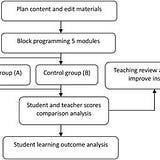
Çalışmanın kavramsal çerçevesi Şekil 1'de gösterilmektedir. Çalışmanın başlangıcı, blok programlama için içerik ve öğretim materyali nasıl planlanır ve yazılır sorusuyla başlar, ardından sınıfı deney grubu (akran değerlendirme grubu) ve geleneksel öğretim grubu (kontrol grubu) olarak böler ve farklı öğretim modellerinin öğrenci performansını nasıl etkilediğini keşfetmek için ilk beş modülün öğretimi takip eder. Daha sonra öğrenci başarısı ve görevle ilgili veriler karşılaştırılacak; dönemin ikinci yarısı için öğretim modelini ayarlamak için öğretim değerlendirmesi ve yansıtması yapılacaktır. Son olarak, ayarlanmış öğretim modelini kullanarak öğrenci öğrenme sonuçları analizi yapılacaktır
Figure 1
Figure 1. Conceptual framework.
Figure 1. bu çalışmanın yapısını ve prosedürlerini göstermektedir. Modül tabanlı bir kurs programı hazırlamak için 10 hafta sürdü, bu süreçteki ilk beş ünite bu araştırmada ele alınmıştır. Ardından, bu beş ünitenin öğretimi ve öğrenmesine 9 hafta ayrılmıştır. Bu süreçte geleneksel öğretim yöntemi uygulanmıştır. Deney ve kontrol gruplarının raporladığı sonuçları karşılaştırmak için 2 haftalık bir deney yapılmıştır. Her iki grup da aynı içeriğe sahip ancak farklı soru sıralamalarına sahip bir test verildi; ardından akran değerlendirmesi ile öğretmen değerlendirmesi arasındaki puan farkı incelenmiş, yansıtma ve geri bildirim yapılmıştır. Bu, bir sonraki program için ders programı ve öğretim yöntemlerini ayarlamalarına yol açtı. Aynı zamanda, farklı öğretim yöntemlerinin ödevler ve başarılar üzerinde nasıl etkilediği konusunda tartışmalar yapılmıştır. Daha sonra notları ve ödev puanlarını karşılaştırmak için 3 hafta ayrılmıştır. Öğrenci başarılarının sonucuna varmadan önce beş ünite için öğretim yöntemini ayarlama olasılığını keşfetmek için istatistiksel analiz yapılmıştır
Brigade Laboratuvarı Yöntemi
Öğrencilerin geri bildirimleriyle ders ilerlemesini ve içeriğini nasıl ayarlanacağını anlamak çok önemlidir. Öğrencilerin öğrenme durumunu anlamak için değerlendirme, eğitimde en doğrudan ve belirgin yolunudur. Genellikle öğrencilerin sınıf içeriğini ne kadar içselleştirdiğini anlamak için kullanılır. Çalışma, temel programlama dersinde bilgi bilimi ile ilgili bölümlerdeki öğrencilere odaklandı; Konular deney grubuna ve kontrol grubuna ayrılmıştır, Tablo 1'de gösterildiği gibi. Deney grubu, akran değerlendirmesi ve öz değerlendirme ile yeni öğretim modelini benimsemiştir; kontrol grubu ise geleneksel ders modelini benimsemiştir. Arasınavdan sonra, ilk öğretim değerlendirmesi yapıldı ve müfredat buna göre ayarlandı, ardından öğretim döneminin ikinci yarısı geldi. Yeni bir öğretim modelinin, geleneksel modele göre programlama öğrenme sonucunu daha iyi getireceği bekleniyordu. Yeni öğretim modeli altındaki öğrencilerin, problem çözme ve mantıksal düşünme konularında programlamayı uygulamada geleneksel öğretim modeli altındaki öğrencilere göre daha başarılı olmaları bekleniyordu
Table 1

Table 1.Araştırma hipotezleri için deney grubu ve kontrol grubu
Uygulama Adımları ve Akran Değerlendirme Kriterleri
Çalışmanın konuları bilgi bilimlerinin yeni başlayanlarıydı ve ders programlamaydı. Çalışma, öğrencilerin notlarını hesaplamak için akran değerlendirmesi kullandı ve bu, öğrencilerin kendi işlerinin güçlü ve zayıf yönlerini keşfetmelerine ve programlama yeteneklerini yükseltmelerine olanak sağladı. Değerlendirmede altı aşama bulunmaktaydı: (1) Görevin teslimi: Öğrenciler görevlerini dijital öğrenme platformu sistemine teslim ettiler. (2) Görev değerlendirmesi: Öğrenciler, değerlendirme kriterlerini takip ederek görevi puanladılar. (3) Öğretmen değerlendirmesi: Öğretmen, görevi puanladı. (4) Akran değerlendirmesi: Öğrenciler, sunum yapan öğrencileri puanladılar. (5) Kendi değerlendirmesi: Öğrenciler, kendi işlerini ve diğerlerini puanlarken aynı zamanda kendi işlerini puanladılar. (6) Görev performansı: Akran ve öğretmen değerlendirmesinin tamamlanmasının ardından, öğrenciler geri bildirimlere dayalı olarak düzeltmeler yaptılar. Geleneksel değerlendirme yöntemi iki aşamaya ayrılır: (1) Sınav aşaması: Öğretmen sınıfta ara sınav ve final sınavları düzenler. (2) Öğretmen değerlendirmesi: Öğretmenler öğrencilerin ara sınav ve final sınavlarını puanlar. Bu çalışma, akran değerlendirme kriterlerini (Tablo 2) aşağıdaki prensiplere dayalı olarak oluşturdu: (1) Programlama mantığı dersi için puanlama kriterlerini tasarlayın. (2) Değerlendirme unsurlarını oluşturun ve değerlendirme standardını tanımlayın. (3) Değerlendirmenin açıklaması anlaşılır olmalıdır. (4) Değerlendirme standardının maddeleri ve alt başlıkları net ve kesin olmalıdır. (5) Her seviyenin standartlarını belirleyin, örneğin mükemmel, çok iyi ve adil gibi. (6) Her seviyenin puan aralığını belirleyin. (7) Değerlendirme örneğinin kriterleri kullanarak işlemlerin sayısını hesaplayın. (8) Öğrenci geri bildirimlerini dinleyin ve gerektiğinde düzeltin. (9) Yeni değerlendirme kriterlerini öğrencilere iletişim kurarak ve tartışarak tanıtın ve onların değerlendirme standardını anladığından emin olun.
Table 2
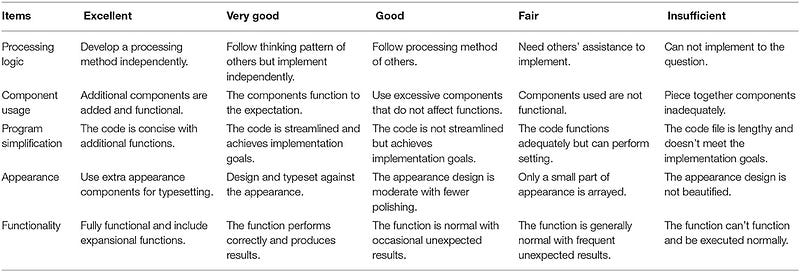
Table 2. Akran değerlendirme kriterleri.
Sanal sınav, önceden öğrenci kaydı ve sınav alma kılavuzu ile ayarlanmış olan bir akıllı telefon veya bilgisayar aracılığıyla yapılır. Bulut tabanlı sınav sistemine giriş yaptıklarında, öğrenciler ders ve ilgili sınav hakkında bir bildirim alırlar. Bu gerçek zamanlı sistem, sınavı alan kişilerin anonim kalmasına, akranlarıyla etkileşimde bulunmasına ve sınavdan öğrenilen derslere ilişkin düşünmelerine olanak tanır. Sonuç olarak, öğrenciler dersi daha çekici bulurlar. Sınavdan önce öğrencilerin akran değerlendirme kriterleri ve Zuvio kılavuzunu tanımaları gerektiğini belirtmek önemlidir. (Table 2).
Veri İşleme ve Analiz Yaklaşımı
Çalışma, deney grubu ve kontrol grubunun veri dağılımını öğretmen değerlendirmesi karşısında analiz etti ve ana bölüm ve ana olmayan gruplar üzerinde puan analizi yaptı. Öğrencilerin öğrenme ilerlemesini daha iyi anlamak ve öğrenci ile öğretmen arasındaki puan farklarını analiz etmek için çalışma aşağıdaki iki göstergeyi hesapladı ve göstergelerdeki değişiklikleri analiz etti. Bu çalışma, 72 öğrencinin performansını incelemektedir. Gruplandırmadan önce, programlama mantığı hakkında temel bilgiyi test etmek için 10 soruya cevap verdiler. İncelenenlerin 38'i bazı temel bilgilere sahipti, geri kalan 34'ü ise hiçbir bilgiye sahip değildi. İlk grup 6.78 puan alırken, ikinci grup 3.56 puan aldı, aralarında 3.22 puanlık bir fark bulunmaktadır. Bu, arka plan bilgisinin önemli olduğunu göstermektedir.
Öğrenci Mesleki Yaklaşım Düzeyi
Öğrenci mesleki yaklaşım düzeyi göstergesi (Tablo 3) aracılığıyla, öğrenci ile öğretmen arasındaki puan farkını anlamak mümkündür. Öğretmen, öğrencilerle farkı tartışabilir ve öğrencilere sınıfta puanlama yaparken öğretmenin değer verdiği öğretme hedeflerini anlatabilir. Tablo 3'teki rakam yüzde büyüme oranıdır. Rakamın aralığı Liu (2016) tarafından belirlenmiştir; 1+ ise, öğrencinin öğretmene yaklaşık olarak %100 ulaştığı anlamına gelir; 0.95, öğrencinin öğretmenin mesleki derecesinin yaklaşık %95'ine ulaştığı anlamına gelir; 0.8, öğrencinin öğretmenin mesleki yeteneklerinin yaklaşık %80'ine ulaştığı anlamına gelir. Bu rakam, öğretmenin 0 ila 100 arasındaki puanlaması ile aynıdır. Üçüncü bir tarafın bakış açısından öğretmen ve öğrencinin puanlamasını gözlemleyerek nesnel bir mesleki değer elde edilir. Öğrencinin mesleki yaklaşım düzeyi = Akran değerlendirmesinin ortalama puanı / Öğretmen değerlendirmesinin puanı
Table 3
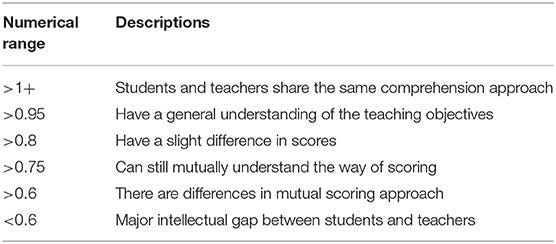
Table 3. Student professional approach table.
Student Self-Professional Growth Change
After students experienced assessment more than once, they can conduct comparison on the degree of difference based on the score data and understand their learning status according to the magnitude of the difference. Students can discuss whether the benchmark of scoring results can effectively improve the learning outcome and understand the accomplishment status of current curriculum and teaching objectives based on multiple records. Formula 2 can be used to calculate student professional growth change value, which can be applied to Table 4 to understand the student professional growth rate.
Students′ self−professional growth change =1−nth assignmentn−1th assignment (2)
Table 4
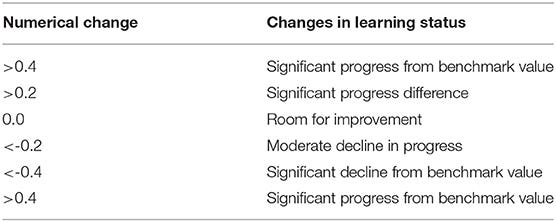
Table 4. Student self-professional growth change table.
Analytical Assessment on Course Content
The five stages of the course content in this study are detailed in Table 5. Stage 1 is course planning. The English program code of the text interface is first changed into block programming or a set of block programming material is designed to allow easy learning for students. Stage 2 is to incorporate peer assessment into the course when it was appropriate. This is the learning stage for students using the development environment provided by Mit App Inventor 2. The reason for adopting Inventor 2 is that students can have easy access with a Google account. In addition, it is operated on the webpage, and no additional program download is required. Inventor 2 is a block-type programming, which is in line with the research direction of the study. Another purpose of this stage is to employ the self-developed material to observe whether students have improved their performance in programming through using block program. Stage 3 is the assessment stage. The tool employed is Zuvio. Zuvio was developed to strengthen students’ and teachers’ development capacity. The many functions it provides include peer assessment, teacher–student interaction, and student feedback. Zuvio also provides quantitative analysis; thus, this study mainly takes Zuvio to conduct peer assessment and student feedback. Stage 4 is data analysis. Software used is R; the reasons are described in sections Literature Review, Conceptual Framework, and Learning Effectiveness Analysis. In this stage, mainly the assessment data are used for analysis and integration to analyze students’ learning status. The last stage is improvement which improves the course content based on the analytical data and consolidated data, including student feedback.
Table 5
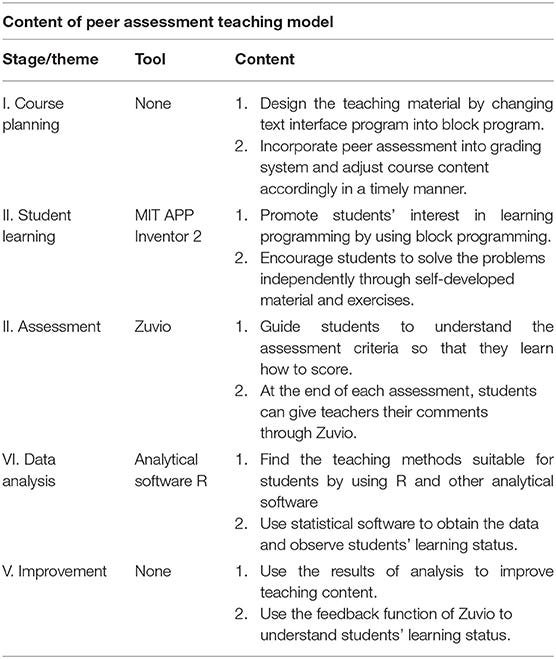
Table 5. Student self-professional growth change.
Learning Effectiveness Analysis
The subjects of the study were the students in the mobile device development course. A total of 72 students divided into 18 groups participated in this research, and the students were grouped freely, with each team having four students. Experimental class (A) and control class (B) were conducted in this research. Experimental class included non-information major students (A1) and information major students (A2), and control class included non-information major students (B1) and information major students (B2). The analysis of students’ learning effectiveness is given as follows.
Relationship Between the Professional Level of the Teacher and Student Scoring
The scores of the midterm and final examinations were calculated by using formula 1, and the results are shown in Table 6. It can be seen that both the degree of approach between the midterm and final examinations was >0.9, indicating the difference between the students’ and teacher’s understanding of the scoring method is small. According to Table 7, the progress range of class A was 0.02, indicating the students have made slight improvement in grades, but there still existed room for improvement; the progress range of class B was 0.19, indicating students have made significant growth in the progress range.
Table 6

Table 6. Teacher and student score approaching degree.
Table 7
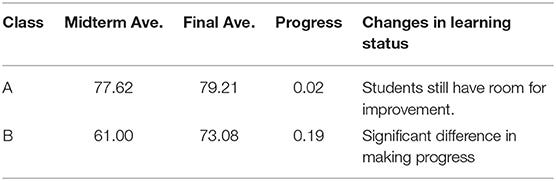
Table 7. Student self-grow change.
Figure 2 shows two sets of midterm and final examination scores for experimental group A and control group B. The scores are based on peer assessment and teacher’s evaluation. Another score indicating cognitive differences between the two groups for midterm examination performance hovers around 0.93 and 0.94, suggesting the influence of unfamiliarity with the rubrics. By the final examination, cognitive difference of group B is narrowed down to 0.90. However, students in this group make no notable progress. By contrast, average scores in experimental group A are higher than those of midterm examination grades, while the cognitive difference stays at 0.94, showing learning progress and familiarity with the rubrics.
Figure 2
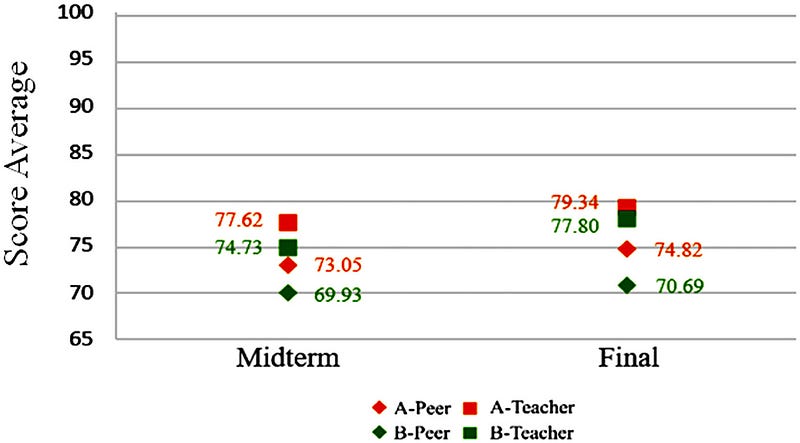
Figure 2. Teacher and student score approaching degree.
Approaching Relationship Between Student and Teacher Scores
Teacher scores and student scores are presented in the distribution chart; the horizontal axis is the teacher score, and the vertical axis is the student score. Through the peer evaluation methods at the middle and end of the period, the range of the distribution points of the results is observed to understand the students’ learning effectiveness. The progress rate is calculated by the aforementioned formula. Figures 3, 4, respectively, show the midterm and final examination grade distribution of the two classes, where the small point is the average score of the 18 groups, and the larger point is the overall average of the group. According to the original classification of the non-information major group (A1), the experimental class information major group (A2), the control class non-information major group (B1), and the experimental class information major group (B2), the average score of the information major group is higher than that of the non-information major group, and the scores of the experimental class are higher than those of the control class. It can be seen that when the experimental class uses the peer evaluation method, the students’ learning status and results are better than the those using the traditional evaluation method of the control class.
Figure 3
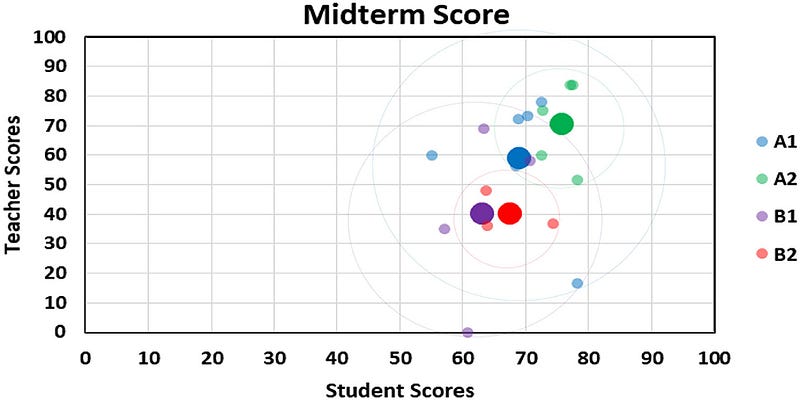
Figure 3. Midterm score approach: classes A1, A2, B1, and B2.
Figure 4
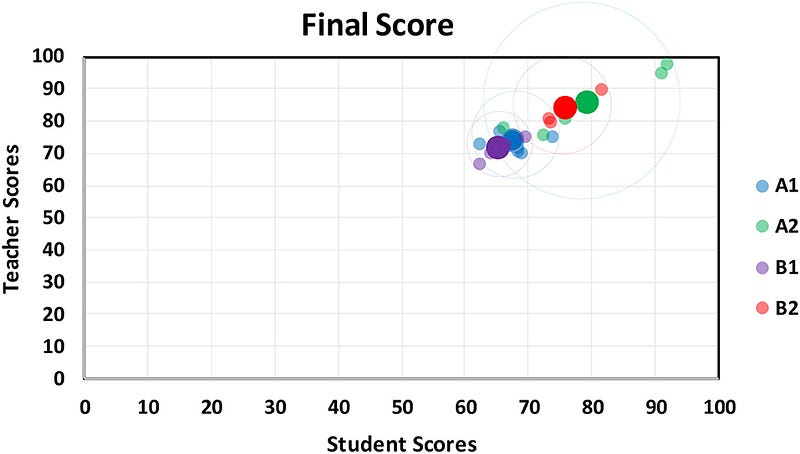
Figure 4. Final score approach: classes A1, A2, B1, and B2.
Midterm examination results show the following findings: the average score of A2 and B2 students who have some knowledge of information science is higher than that of A1 and B1 peers who are first-time learners within the same class; the grade gap among learners in A2 and B2 is narrower, indicating that background knowledge of programming logic does make a difference.
Final examination results show a similar trend in average scores. Nevertheless, the grade gap among all students becomes narrower, with the average scores of the four groups increasing. It is clear proof that such a teaching method is well-received by students and that peer pressure has positive impacts. In other words, such innovative programming and peer assessment can enhance student performance.
Student scores and teacher scores were presented, respectively, in the distribution chart, with the horizontal axis as the student seat number and vertical axis as the scores given by the student and teacher. There were two types of graphs in the charts representing teacher or student scores, respectively. The round dot represents the score from peer assessment; the triangle represents the score from the teacher with the score indicated on the left. The figure below the graph represents the approaching degree between student and teacher scores, as is shown in Figures 5, 6. There were two classes in this study. The student numbers of the class are 46 for class A and 26 for class B. Each class was divided into several groups, with 11 groups in class A and 7 groups in class B. According to Figures and formula 1, it can be observed that the scores of both teacher and students in most groups were >1, indicating the students and teacher had the same understanding of the assessment criteria. A few groups did show a significant deviation from the teacher scores, for example, for group 7 of class A, the value calculated by the formula was only 0.217, which indicated that a significant gap existed in the judging score benchmark of the group and the teacher.
Figure 5
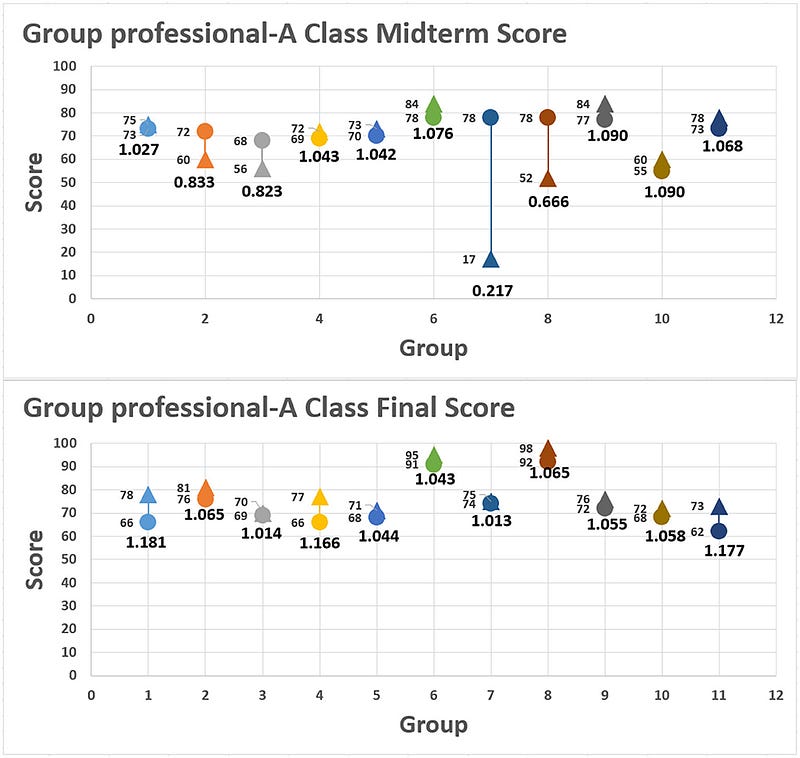
Figure 5. Group professional-level variation: class A.
Figure 6
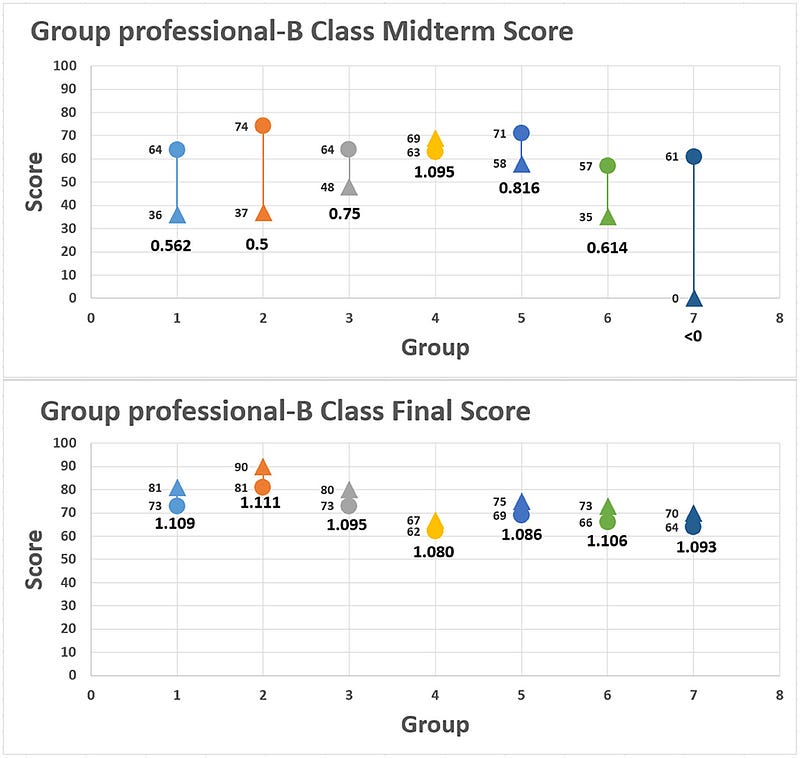
Figure 6. Group professional-level variation : class B.
The assessment also allowed students to substitute their assignment scores into formula 2 to measure their own progress. Students’ self-evaluation rubrics are shown in Figures 7, 8, with the horizontal axis as the student seat number and vertical axis as the scores given by the students and teacher. The round dot represents the score of the first assignment; the triangle represents the score of the second assignment. The scores from both assignments are shown at the left of the distribution chart, and the value below indicate the range of progress or regression calculated by using formula 2. The final self-assessment results showed most students demonstrated slight degree of positive growth. For example, №7 of class B made the highest growth rate of 0.42 in the self-assessment, progressing from 43 points to 74 points, as 0.42 > 0.4 representing substantial growth in accomplishing the assignment. The score of №22 (Figures 7, 8) among group 7 (Figures 3, 6) in the control class is given for peer evaluation at the end of the period, but the report was not uploaded to the Zuvio platform. According to the regulations, the teacher cannot score it, so it is 0 point.
Figure 7
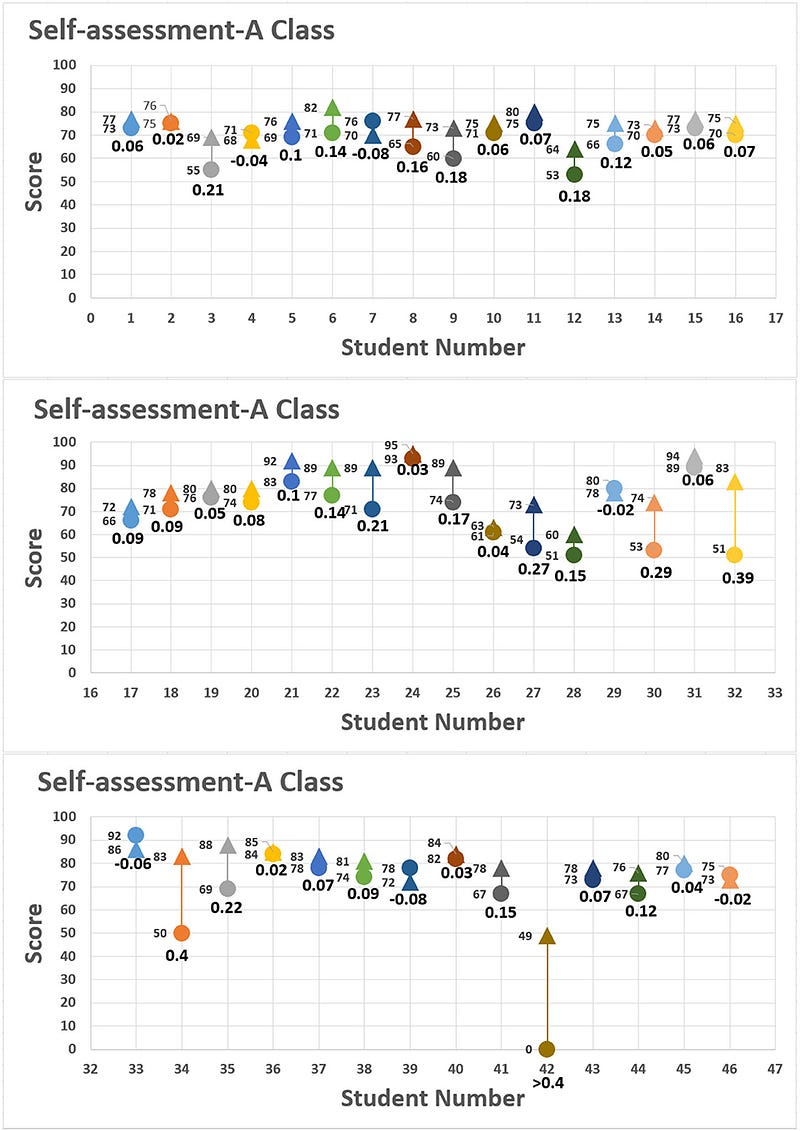
Figure 7. Self-assessment: class A.
Figure 8

Figure 8. Self-assessment: class B.
The study is fully aware that students who have no background knowledge of programming find it challenging to familiarize themselves with the English-language interface and syntax. To address this challenge, this research introduces an innovative teaching method that is reinforced by peer assessment rubrics and interactive instruction platforms and explores the potential of peer pressure and block programming. Through discussion and sharing, students become more adept at articulating ideas, solving problems, and cooperating with team members.
Discussion
The study introduces an innovative teaching method that is reinforced by peer assessment rubrics and interactive instruction platforms, and explores the potential of peer pressure and block programming. Grades of experimental and control groups are analyzed, indicating that such a method does improve programming learning performance in the traditional educational context. Thus, the study suggests that college teachers and programming trainers adopt such a method to turn peer pressure into enhanced performance.
It is not surprising to find that students who have no prior exposure to programming do not fare well in the traditional educational context, which in turn undermines their motivation and confidence. Therefore, introducing more learning strategies and platforms should not aim to engage students’ interest but to motivate them to overcome difficulties and improve learning outcomes.
Figure 9 shows cognitive differences among A1, A2, B1, and B2 for midterm and final examination scores. Average scores based on peer assessment and teacher’s evaluation rise to some extent. Cognitive differences for B1 and B2 are higher than those of A1 and A2, suggesting the former two groups’ unfamiliarity with the rubrics. Between A1 and A2, with the former knowing nothing about programming and the latter having some background knowledge, cognitive differences are smaller, which can be attributed to the familiarity with peer assessment rubrics.
Figure 9
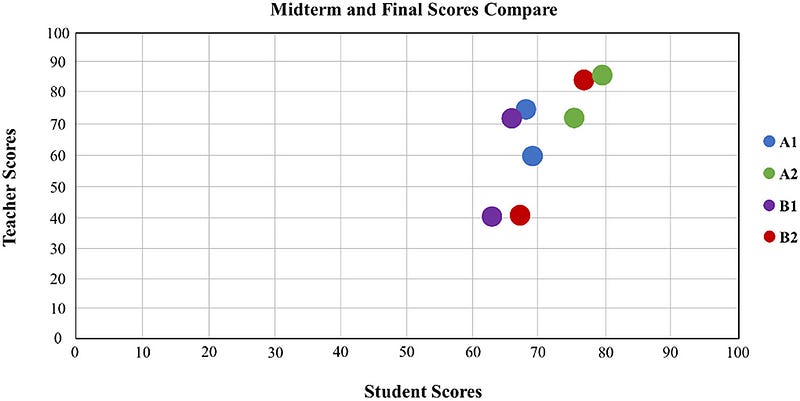
Figure 9. Midterm and final examination score comparison: classes A1, A2, B1, and B2.
The experimentation results indicate that grouping is not a differentiating factor because both groups showed signs of improvement. Nevertheless, it is worth noting that when engaging in peer assessment at the initial stage, students with no background information were more productive than those taught by the traditional method, suggesting that peer pressure is a motivator and enhancer of learning outcomes. In the second stage, the learners also delivered better performance than the control group, suggesting that peer pressure, companionship, and instruction do improve beginners’ performance.
The instruction of computational thinking begins with its definition and teaching method. The first step is to differentiate between mathematical thinking and computational thinking. The latter covers four aspects: data application, modeling and simulation, problem-solving, and systemic thinking. This research focuses on the latter two. To this end, the authors examine related studies, as well as 101 block-based programming environments, of which 46 are analyzed to compare different designs that support the transition to text-based programming. Totally, 10 principles of tool construction are provided. An innovative teaching method is created to facilitate the learning of block-based programming and to improve learning performance.
Conclusion
The study analyzes the data obtained from the procedures, and peer assessment is a distinguishing feature of it. Class A and B students reported that high-school or vocational school courses related to information science did influence their performance. However, this perceived difference is not validated by either peer assessment or instructor evaluation. Both scores are higher than 0.90, suggesting that students and the instructor have a similar understanding of the course’s objectives. One possible explanation is that the familiarization with the peer assessment rubrics gives students a deeper understanding of what they are expected to achieve. As for the indicator of self-improvement, the difference among class A students between midterm and final examination results is 0.02, suggesting considerable room for growth. The difference for class B students is 0.19, indicating significant progress. Therefore, the familiarization with the peer assessment rubrics has an influence on the scoring distribution of instructor evaluation and peer review. The dispersion for the midterm examination is more scattered. In the final examination, the dispersion is more clustered, indicating that benchmark values between peer assessment and instructor evaluation are close. It also shows that students and their peers achieved a general consensus on how to gain the specialized knowledge and how to gauge peer assessment.
The study incorporated peer evaluation mechanism in a classroom setting to understand whether the new instruction model was beneficial to student learning in higher education. Exploring role identity within the social identity theory enables us to understand better how the role or identity impacts engagement, retention, and persistence. The study employed Zuvio for peer evaluation. The results showed that in classes A and B, for those who majored in information science in regular high school or vocational high school, the variation in professional approach degrees was limited. Thus, in terms of programming, the variation between student scores and teacher scores was limited. The students’ professional approach degree value was higher than 0.90, which indicated that students and teacher had similar understanding of the teaching objectives. On the other hand, when analyzing the self-professional growth changes of classes A and B, it was found that the self-professional growth change range for class A was 0.02, which indicated that there was still room for improvement in learning growth. Class B demonstrated a 0.19 change range. In other words, all students have sustainable development in their reflective learning. In learning, there was a significant progress in the final than in the midterm examination. In the approaching relationship between the teacher and students, both teacher scores and student scores were presented in the distribution chart. Through the dot distribution, it can be found that the spread was more scattered, indicating a larger variation between teacher and student scores. In final assessment, the spread was more intense, indicating students’ peer assessments already have a similar perspective with the teacher assessment, and they shared the same understanding on professional knowledge and assessment methods.
The results show that peer evaluation reaches a sustainable development goal in programming education. Non-information major students within peer evaluation have higher effective learning in programming than those in traditional teaching methods in the beginning stage, which means that students are more likely to learn programming because of peer pressure. Non-information major students also show higher learning effectiveness in the second stage than those in the control class, which means that under the pressure and guidance of peers, peer assessment teaching makes students more attractive to programming courses.
The study designed an innovative teaching method whose effectiveness is examined by analyzing the grades of experimental and control groups, with a greater emphasis on the learning performance of the former. Students in this group have no prior exposure to programming. Nevertheless, final examination results indicate that their performance is improved, better than that of their counterparts in the control group. In other words, the innovative teaching method does make a difference.
Given that programming logic and similar courses are attached greater importance by higher education institutions, how to replace the traditional teaching method with innovative ones and ensure the latter suits the current learning environment deserves serious attention. The methodology and innovative teaching method designed by this research can provide some inspiration for college teachers and programming trainers who can guide students to cope with peer pressure, and improve learning performance.
Limitation and Future Work
The study has some limitations: (a) the course spans only one semester; (b) few classes and learners engage in the experiment; and © the division of category or group needs to be more precise. Thus, statistical accuracy needs to be increased. If this experiment is run for years to have more data collected, statistical accuracy will be ensured, and clear patterns be found.
Based on the conclusion, the authors suggest that peer assessment, an innovative teaching method, should be adopted for module-based course instruction. Compared to the traditional teaching style, peer pressure and comparison motivate students to do better and engage their learning interest in programming. But the one-size-fits-all approach should be avoided. The peer assessment rubrics should take into account learners’ characteristics. The fundamental criterion should be whether such assessment maximizes learning outcomes.
Data Availability Statement
The original contributions presented in the study are included in the article/supplementary material, further inquiries can be directed to the corresponding authors.
Ethics Statement
Ethical review and approval was not required for the study on human participants in accordance with the local legislation and institutional requirements. Written informed consent from the [patients/participants OR patients/participants legal guardian/next of kin] was not required to participate in this study in accordance with the national legislation and the institutional requirements.
Author Contributions
T-CH and Y-HC: conceptualization and data curation. T-LC: methodology. T-LC and C-YC: software. T-CH, Y-HC, and C-CC: validation. T-CH: formal analysis, investigation, and funding acquisition. T-CH and C-CC: resources, supervision, and project administration. T-LC and T-CH: writing — original draft preparation, writing — review and editing, and visualization. All authors have read and agreed to the published version of the manuscript.
Funding
This research was supported by the Fundamental Research Funds for the Central Universities (Grant Number 3213049408), projects under MOST 108–2221-E-390–005 and MOST 108–2622-E-390–002-CC3. This research was also supported by the major education and teaching reform projects in Fujian undergraduate colleges and universities in 2019 (grant FBJG20190284).
Conflict of Interest
The authors declare that the research was conducted in the absence of any commercial or financial relationships that could be construed as a potential conflict of interest.
Publisher’s Note
All claims expressed in this article are solely those of the authors and do not necessarily represent those of their affiliated organizations, or those of the publisher, the editors and the reviewers. Any product that may be evaluated in this article, or claim that may be made by its manufacturer, is not guaranteed or endorsed by the publisher.
References
Calder, N. (2010). Using scratch: an integrated problem-solving approach to mathematical thinking. Aust. Prim. Math. Classr. 15, 9–14.
Chen, T. L., Hsiao, T. C., Kang, T. C., Wu, T. Y., and Chen, C. C. (2020). Learning programming language in higher education for sustainable development: point-earning bidding method. Sustainability. 12, 1–14. doi: 10.3390/su12114489
CrossRef Full Text | Google Scholar
Finn, G. M., and Garner, J. (2011). Twelve tips for implementing a successful peer assessment, medical Teacher 33, 443–446. doi: 10.3109/0142159X.2010.546909
PubMed Abstract | CrossRef Full Text | Google Scholar
Hickey, D. T., Robinson, J., Fiorini, S., and Feng, Y. A. (2020). Internet-based alternatives for equitable preparation, access, and success in gateway courses. Internet High. Educ. 44, 1–9. doi: 10.1016/j.iheduc.2019.100693
CrossRef Full Text | Google Scholar
Hillsdale, N. J., Lawrence, E., Piteira, M., and Costa, C. (2019). “Learning Computer Programming: Study of Difficulties in Learning Programming,” in International Conference on Information Systems and Design of Communication, ACM Lisbon, Portugal (2013).
Ion, G., Marti, A.S., and Morell, I. A. (2019). Giving or receiving feedback: which is more beneficial to students’ learning? Assess. Eval. High. Educ. 44, 124–138. doi: 10.1080/02602938.2018.1484881
CrossRef Full Text | Google Scholar
Kordaki, M. (2012). Diverse categories of programming learning activities could be performed within scratch. Procedia. Soc. Behav. Sci. 46, 1162–1166. doi: 10.1016/j.sbspro.2012.05.267
CrossRef Full Text | Google Scholar
Ladias, A., Karvounidis, T., and Ladias, D. (2021). Classification of the programming styles in scratch using the SOLO taxonomy. Adv. Mob. Learn. Educ. Res. 1, 114–123. doi: 10.25082/AMLER.2021.02.006
CrossRef Full Text | Google Scholar
Ladias, A., Karvounidis, T., and Ladias, D. (2022). Forms of communications in scratch and the SOLO taxonomy. Adv. Mob. Learn. Educ. R. 2, 234–245. doi: 10.25082/AMLER.2022.01.007
CrossRef Full Text | Google Scholar
Liu, J., Guo, X. Y., Gao, R. Q., Fram, P., Ling, Y., Zhang, H., et al. (2018a). Students’ learning outcomes and peer rating accuracy in compulsory and voluntary online peer assessment. Assess. Eval. High. Educ. 44, 835–847. doi: 10.1080/02602938.2018.1542659
CrossRef Full Text | Google Scholar
Liu, X. Y., Li, L., and Zhang, Z. H. (2018b). Small group discussion as a key component in online assessment training for enhanced student learning in web-based peer assessment. Assess. Eval. High. Educ. 43, 207–222. doi: 10.1080/02602938.2017.1324018
CrossRef Full Text | Google Scholar
Liu, Y. C. (2016). Development and evaluation of rubrics for assessing the performance of college students in human resource management courses. Educ. J. NHCUE. 33, 77–108. doi: 10.3966/199679772016063301003
CrossRef Full Text | Google Scholar
Liu, Z., Kong, X., Liu, S., Yang, Z., and Zhang, C. (2022). Looking at MOOC discussion data to uncover the relationship between discussion pacings, learners’ cognitive presence and learning achievements. Educ. Inf. Technol. doi: 10.1007/s10639–022–10943–7
PubMed Abstract | CrossRef Full Text | Google Scholar
Liu, Z., Liu, S., Liu, L., Sun, J., Peng, X., and Wang, T. (2016). Sentiment recognition of online course reviews using multi-swarm optimization-based selected features. Neurocomputing. 185, 11–20. doi: 10.1016/j.neucom.2015.12.036
CrossRef Full Text | Google Scholar
Liu, Z., Yang, C., Sylvio, R, Liu, S., and Wang, T. (2019). Temporal emotion-aspect modeling for discovering what students are concerned about in online course forums. Interact. Learn. Environ. 27. 598–627. doi: 10.1080/10494820.2019.1610449
CrossRef Full Text | Google Scholar
Luaces, O., Diez, J., and Bahamonde, A. (2018). A peer assessment method to provide feedback, consistent grading and reduce students’ burden in massive teaching settings. Comput. Educ. 126, 283–295. doi: 10.1016/j.compedu.2018.07.016
CrossRef Full Text | Google Scholar
Lundstrom, K., and Baker, W. (2009). To give is beter than to receive: the benefits of peer review to the reviewer’s own writing. J. Second Lang. Writ. 18, 30–43. doi: 10.1016/j.jslw.2008.06.002
CrossRef Full Text | Google Scholar
Mine, C. R., and Colin, R. (2018). Infrastructure and tools for teaching computing throughout the statistical curriculum. Am. Stat. 72, 58–65. doi: 10.1080/00031305.2017.1397549
CrossRef Full Text | Google Scholar
Murillo-Zamorano, L. R., and Montanero, M. (2018). Oral presentations in higher education: a comparison of the impact of peer and teacher feedback. Assess. Eval. High. Educ. 43, 138–150. doi: 10.1080/02602938.2017.1303032
CrossRef Full Text | Google Scholar
Nielsen, K. (2014). Self-assessment methods in writing instruction: a conceptual framework, successful practices and essential strategies. J. Res. Read. 37, 1–16. doi: 10.1111/j.1467–9817.2012.01533.x
CrossRef Full Text | Google Scholar
Papadakis, S. (2018). Is pair programming more effective than solo programming for secondary education novice programmers?: a case study. Int. J. Web-Based Learn. Teach. Technol. 13, 1–16. doi: 10.4018/IJWLTT.2018010101
CrossRef Full Text | Google Scholar
Papadakis, S., and Kalogiannakis, M. (2019). Evaluating the effectiveness of a game-based learning approach in modifying students’ behavioural outcomes and competence, in an introductory programming course. A case study in Greece. Int. J. Teach. Case Stud. 10, 235–250. doi: 10.1504/IJTCS.2019.102760
CrossRef Full Text | Google Scholar
Papadakis, S., and Orfanakis, V. (2018). Comparing novice programing environments for use in secondary education: app inventor for android vs. alice. Int. J. Technol. Enhanc. Learn. 10, 44–72. doi: 10.1504/IJTEL.2018.088333
CrossRef Full Text | Google Scholar
Piteira, M., and Costa, C. (2013). “Learning computer programming: study of difficulties in learning programming,” in Proceedings of the 2013 International Conference on Information Systems and Design of Communication (Lisbon), 75–80.
Roy, K. (2012). “App inventor for android: report from a summer camp,” in SIGCSE ’12 Proceedings of the 43rd ACM Technical Symposium on Computer Science Education (Raleigh, NC), 283–288.
Seifert, T., and Feliks, O. (2019). Online Self-Assessment and Peer-Assessment as a Tool to Enhance Student-Teachers’ Assessment Skills. Assessment & Evaluation in Higher Education. 44, 169–185. doi: 10.1080/02602938.2018.1487023
CrossRef Full Text | Google Scholar
To, J., and Panadero, E. (2019). Peer assessment effects on the self-assessment process of first-year undergraduates. Assess Eval. High. Educ. 44, 920–932. doi: 10.1080/02602938.2018.1548559
CrossRef Full Text | Google Scholar
Zahedi, L., Batten, J., Ross, M., Potvin, G., Damas, S., Clarke, P., et al. (2021). Gamification in education: a mixed-methods study of gender on computer science students’ academic performance and identity development. J. Comput. High. Educ. 33, 441–474. doi: 10.1007/s12528–021–09271–5
CrossRef Full Text | Google Scholar
Keywords: technical education, sustainable education, peer review, graphical user interface, block-based computer programming language logic design
Citation: Hsiao T-C, Chuang Y-H, Chen T-L, Chang C-Y and Chen C-C (2022) Students’ Performances in Computer Programming of Higher Education for Sustainable Development: The Effects of a Peer-Evaluation System. Front. Psychol. 13:911417. doi: 10.3389/fpsyg.2022.911417
Received: 04 April 2022; Accepted: 20 June 2022;
Published: 13 September 2022.
Edited by:
Stamatios Papadakis, University of Crete, Greece
Reviewed by:
Natanael Karjanto, Sungkyunkwan University, South Korea
Zhi Liu, Central China Normal University, China
*Correspondence: Tzer-Long Chen, tlchen@kmu.edu.tw; Chih-Cheng Chen, chenccheng@fcu.edu.tw